

Digital product passport for sustainable products
[This article has been updated]
Digital transformation is moving fast and reshaping almost every industry—and manufacturing, trade, and distribution are no exception. To drive transparency and compliance across these sectors, the EU is introducing the digital product passport (DPP). The DPP is a standardized digital dataset that provides instant access to key product information, including material composition, chemical ingredients, repairability, spare parts availability, and much more.
In this article, we look at how the EU’s product passport is shaping the future of sustainable products. We cover the drivers behind its launch, the compliance obligations for manufacturers, the rollout timeline, and the benefits it offers businesses and consumers across the entire supply chain.
At its core, the digital product passport is a data hub. By scanning a QR code on the item, businesses and consumers can instantly access detailed insights into its specific characteristics.
- Transparency: Deep insights into the product lifecycle build consumer trust and enable informed purchasing decisions.
- Efficiency: Centralized, easily accessible data helps businesses streamline and optimize their supply chain management.
- Sustainability: Highly detailed material data drives efficient resource use and better recycling processes, paving the way for greener production and consumption.
When does the Digital Product Passport Take Effect?
The ESPR (Ecodesign for Sustainable Products Regulation) working plan follows a phased approach, meaning certain product groups—such as batteries and textiles—will face compliance sooner than others. Generally, companies will have at least 18 months to comply once a specific regulation comes into force.
The official roadmap is set by the ESPR Working Plan 2025–2030, which was adopted by the European Commission in April 2025. Based on this timeline, the digital product passport will initially focus on:
- Textiles (especially clothing)
- Iron and steel
- Aluminum
- Furniture
- Tires
- Mattresses
Alongside these specific sectors, the EU is rolling out two cross-product mandates focusing on the repairability and recyclability of electrical and electronic equipment.
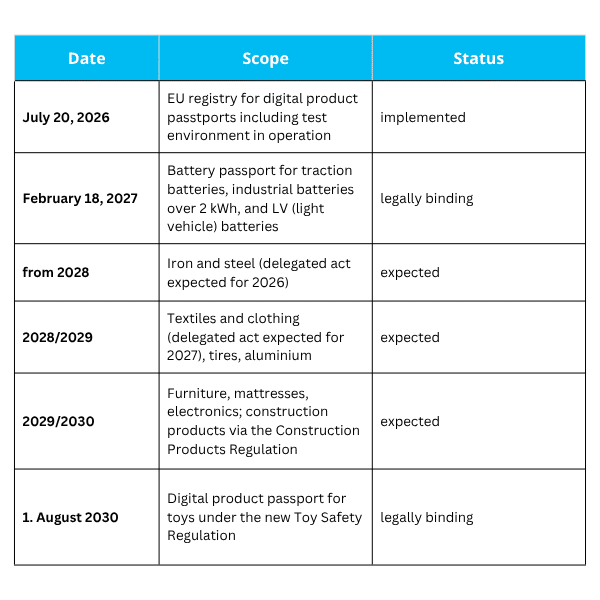
What this means for your roadmap: If your product group faces a compliance deadline of February 2027, your live pilot phases should already be wrapped up. If your deadline falls closer to 2029 or 2030, you are currently in the ideal window to build the necessary DPP infrastructure into your systems.
The Technical Framework: How Does the DPP Work?
The digital product passport relies on modern data carriers like QR codes, NFC tags, and RFID chips to grant instant access to granular product data. The technical specifications for these passports have been standardized since mid-2026.
To create a unified system, the Joint Technical Committee CEN/CLC/JTC 24 developed a modular series of standards for the European Commission. The Commission has officially adopted six of these standards through an implementing decision. Companies that align their systems with these standards benefit from a “presumption of conformity” under Articles 10 and 11 of the ESPR:
- EN 18216:2026: Protocols for data exchange
- EN 18219:2026: Unique identifiers for products, economic operators, and facilities (tracked at the model, batch, or item level depending on the specific product regulation)
- EN 18220:2026: Data carriers (linking the physical item to its digital twin via 2D codes, RFID tags, or NFC chips—including rules on readability, durability, and placement)
- EN 18221:2026: Data storage, archiving, and long-term data availability
- EN 18222:2026: Application Programming Interfaces (APIs) for lifecycle management and search functionality
- EN 18223:2026: Overall system interoperability
Two additional standards covering security, confidentiality, and data authentication are currently in the final stages of approval.
To populate the passport, companies will need to aggregate data from both internal and external sources. Upstream suppliers will provide details on material origins and processing, while downstream partners will contribute data regarding maintenance, end-of-life handling, and disposal. Internally, tracking materials, energy consumption, and quality metrics will offer a comprehensive view of the entire product lifecycle.
Data Privacy: Who Can See What?
A common misconception is that the digital product passport forces companies to make all proprietary data public. This is not true. The ESPR uses a tiered access model, meaning visibility rules are customized for each product category within its specific regulatory act:
- Consumers get access to public-facing information, such as material lists, care instructions, repair guides, and recycling tips.
- Repair shops and recyclers receive deeper technical details, including disassembly blueprints, spare part numbers, and info on hazardous substances.
- Market surveillance and customs authorities are granted access to compliance documentation and registration data.
- Trade secrets, such as proprietary formulas, manufacturing recipes, or vendor pricing, remain strictly protected and confidential.
Two additional standards covering security, confidentiality, and data authentication are currently in the final stages of approval.
To populate the passport, companies will need to aggregate data from both internal and external sources. Upstream suppliers will provide details on material origins and processing, while downstream partners will contribute data regarding maintenance, end-of-life handling, and disposal. Internally, tracking materials, energy consumption, and quality metrics will offer a comprehensive view of the entire product lifecycle.
What Are the Legal Obligations for Manufacturers?
Providing a digital product passport will be mandatory for anyone manufacturing products covered by the ESPR delegated acts. Because these requirements are tailored to specific sectors, the exact data points required will vary by product.
The first major wave of changes arrived with the EU Battery Regulation. Contrary to popular belief, not every single battery requires its own passport. The individual passport mandate is strictly focused on traction batteries for electric vehicles (EVs), industrial batteries with a capacity over 2 kWh, LMT (light means of transport) batteries, such as those found in e-bikes and e-scooters.
Standard household batteries do not require an individual passport, though they must still comply with updated labeling and QR code mandates.
Across most sectors, manufacturers will need to digitize and communicate data such as:
- Assembly and operating manuals
- Interface technologies
- Compliance certificates and proofs of authenticity
- Reusability metrics and material composition
- Energy efficiency ratings
This quick-access data doesn’t just help consumers; it allows waste management facilities to sort and recycle materials efficiently. Public procurement officers can instantly verify environmental compliance, and repair businesses can look up exactly what spare parts are needed to extend a product’s lifespan.
Who Carries the Responsibility: Manufacturers, Importers or Retailers?
DPP compliance is determined by your operational role in the market, not the size of your company:
- Manufacturers must build the passport, keep the data accurate, and log it in the central registry before launching the product.
- Importers bear full responsibility for products coming from non-EU countries. If a shipment lacks a valid DPP registration, it risk being held up at customs.
- Authorized Representatives step in to handle these regulatory duties for international manufacturers without a physical presence in the EU.
- Retailers must ensure the passport remains accessible to customers and are strictly prohibited from removing or obscuring the data carrier.
- DPP Service Providers are authorized to host the data and manage registry entries on behalf of businesses, subject to pending EU quality guidelines.
Moving forward, online marketplaces will also face tougher scrutiny. Regulatory updates will hold e-commerce platforms accountable for verifying that the products listed on their sites are fully DPP-compliant.
Overcoming Implementation Challenges
Much like the adjustments required for Extended Producer Responsibility (EPR) reporting, the DPP presents operational hurdles. Many businesses are concerned about cyber security and data privacy when storing sensitive product information. However, the EU’s focus on decentralized storage, tiered permissions, and standardized data protocols is designed to safeguard corporate data integrity.
Other common roadblocks include upfront implementation costs and resource constraints, especially for teams already stretched thin. Additionally, until digital workflows are fully harmonized across international borders, some administrative overlap with traditional paper documentation may persist.
With proactive planning, transitioning to the digital product passport can be a smooth process. Here are the most common pitfalls and how to address them:
- Fragmented Supplier Data: Material origins and chemical compositions are often trapped in static PDFs or missing entirely. The Fix: Write strict data-sharing requirements directly into your upcoming vendor framework agreements and procurement specifications.
- Lack of Unique Identifiers: Many legacy inventories only track products at the SKU level, lacking batch or individual item serialization. The Fix: Align your numbering systems and labeling workflows with the EN 18219 standard before redesigning your physical packaging.
- Siloed Systems: Product data is often scattered across ERP, PIM, PLM systems, and disconnected spreadsheets. The Fix: Centralize and clean your product master data to create a single source of truth.
Future-Proof Your Business Today
Currently, fragmented data silos mean that crucial product information is rarely accessible on a global scale. The digital product passport bridges this gap, establishing a reliable, worldwide standard for product data transparency.
While the exact placement of the physical data carrier will vary by industry, one thing is certain: the DPP will be a strict requirement for e-commerce. Brands, retailers, and distributors will need to display the passport’s QR code directly on their online product pages.
By assigning internal ownership, launching data audits, and upgrading your IT infrastructure now, you can transform this regulatory requirement into a competitive advantage.
Need expert guidance navigating the new legal and technical framework? Contact our team today—we are here to help you prepare.