



The reporting obligation for packaging in e-commerce is no longer a peripheral issue for many companies. From 2026 onward, it will become a key compliance factor in EU online trade. Any business that places packaging on the market must systematically record quantities, material types, and relevant packaging data – and report them accordingly.
At the same time, marketplaces, fulfillment providers, and authorities are increasing their scrutiny. The necessary structures for complete and accurate data collection are already in place. EPR quantity reporting will become an essential prerequisite for smooth, disruption-free operations for both small online retailers and large enterprises.
Why is the EPR reporting obligation relevant for e-commerce?
E-commerce means shipping – and shipping means packaging. This is precisely where the packaging reporting obligation in online trade comes into effect. Companies that place packaging on the market commercially for the first time in a country are considered “producers” and must register, report quantities, and pay fees (eco-fees). Until now, EPR reporting requirements across the EU have been fragmented, but this is set to change in 2026 with the harmonization of key processes.
As a result, the reporting obligation will become not just a legal requirement, but also an operational responsibility. It impacts your shop’s data management, shipping workflows, and collaboration with logistics providers and marketplaces. Companies that fail to act promptly risk account suspensions, delivery interruptions, and unnecessary costs.
How different EPR rules are across Europe
Although the EU aims to harmonize regulations, starting points vary across member states. In some countries, EPR systems have been long established and strictly enforced, while in others they are only now being developed. These differing national approaches lead to significant variations in how EPR reporting obligations are managed. For example, in some countries, appointing an authorized representative in the destination country is mandatory, whereas in others it is not. You can see the outcome here:
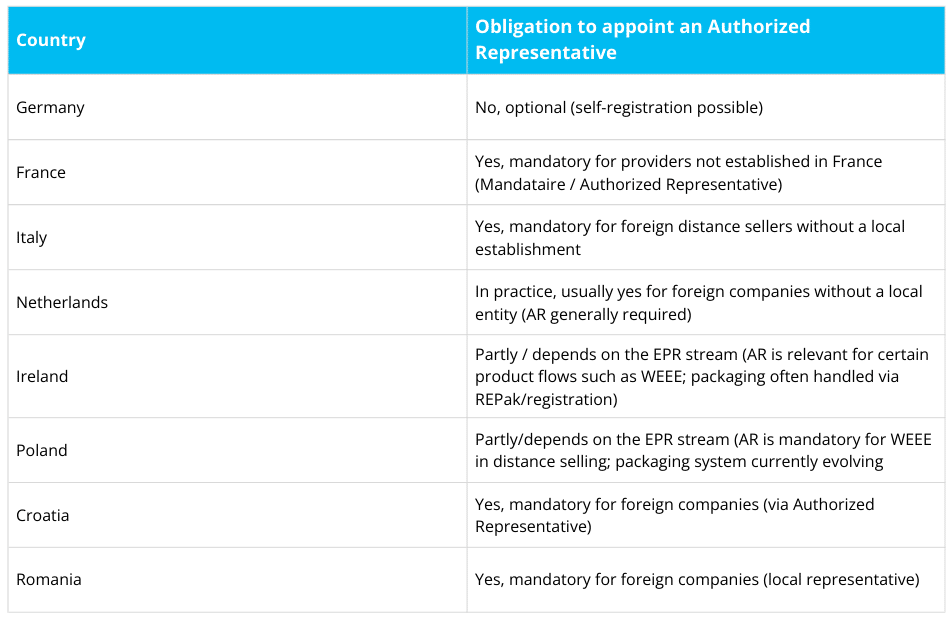
Until now, businesses had to navigate each country’s individual rules—but with the upcoming harmonization, this will no longer be necessary. The result will be simpler processes, more efficient workflows, and clear, consistent structures.
What will change with the EPR reporting obligation in 2026?
The EPR reporting obligation in 2026 marks a clear shift in direction. In the future, all remote sellers – i.e., retailers without a registered office in the destination country – will be required to appoint an authorized representative in every EU country. This representative will handle registration, reporting, and payments. In this way, compliance with applicable regulations is to be ensured not only in the home market but also in other markets.
Even today, representatives are already mandatory in some countries – such as Austria, Spain, Finland, and Portugal. In Germany, this has so far been optional, but this will change with the new reporting obligation for packaging in e-commerce. With these changes, the entire EU will pursue important objectives and strengthen awareness of environmental protection and sustainability.
Fulfillment & shipping service providers: new gatekeepers of compliance
A central aspect of the new EU rules is the strengthened role of fulfillment service providers. In the future, they will actively check whether their customers comply with the reporting obligation for packaging in e-commerce. If data is missing or incomplete, services may be suspended without prior notice.
Marketplaces as active enforcers: Amazon, eBay & Co.
The monitoring obligations of online marketplaces will also be tightened from 2026 onwards. Online marketplaces will verify the EPR compliance of their sellers and, if proof is missing, stop sales or freeze accounts. This development significantly reinforces the reporting obligation for packaging in e-commerce, as marketplaces will become not only platforms but de facto control authorities.
Harmonized data sets: a uniform standard for packaging data
Another milestone is the EU-wide harmonized data set that is intended to apply to all member states. The goal: identical data fields, a uniform reporting format, and reduced administrative effort. The packaging register – which is to be finalized by February 2026 – offers several advantages. With early data structuring, processes can be organized more efficiently and systematically.
Invoices, listings & registration numbers: compliance in day-to-day operations
A particularly practical change concerns documents and listings. In the future, producers must state their national EPR registration number on sales documents – including invoices and marketplace listings. This makes the reporting obligation for packaging in e-commerce visibly part of everyday operations.
What data must be reported – and why accuracy matters
Many retailers underestimate how detailed the EPR reporting obligation for packaging in e-commerce has become. This involves capturing relevant and meaningful data. Reports typically include:
- Material type (e.g., paper, plastic, glass, composites)
- Weight per material fraction
- Packaging category (transport, sales, shipping packaging, etc.)
- Country in which the packaging is first placed on the market
- Reporting period (monthly/quarterly/annually depending on the system)
Especially if you ship to multiple EU countries, the reporting obligation for packaging in e-commerce quickly becomes a data management task. Precise, comprehensive, and well-maintained product, shipping, and packaging data not only reduces risk but also simplifies processes. From 2026 onwards, data management will therefore become a central task.
Quantity reporting for packaging: how does it work in practice?
In practice, the reporting obligation for packaging in e-commerce is fulfilled through quantity reporting. This means you report how much packaging material you have placed on the market in a specific country. Important: this is not about your purchasing volume, but about the packaging that actually reaches the end customer or the respective market.
A practical approach is to create a packaging bill of materials for each product. This consists of the following elements:
- Product packaging
- Shipping carton
- Filler material
- Labels
This provides a reliable basis for calculating quantities in kilograms per material type.
Your next step to properly implement the reporting obligation for packaging in e-commerce
From 2026 onwards, the reporting obligation for packaging in e-commerce will no longer be a mere formality – it will become a prerequisite for reliably selling and shipping within the EU. With a clear data model, sound quantity logic, and the right documentation, you will not only meet legal requirements but also reduce operational risks.
Therefore, start early with proper and complete data collection and make the transition as simple as possible for your business. This way, you will not only master applicable packaging laws but also the reporting obligation for packaging in e-commerce.
FAQ: Reporting obligation for packaging in e-commerce
How often must online retailers report their quantities?
The frequency depends on the respective national EPR system. Some countries require annual reports, others quarterly or monthly – often depending on the quantities or company size. As a general rule: the larger the quantities, the more frequent the reporting. For you, it is crucial to plan reporting deadlines early and continuously update your data. This ensures stress-free compliance with the reporting obligation for packaging in e-commerce.
What are marketplace seller requirements for reporting packaging data?
Marketplace seller requirements for reporting packaging data are becoming increasingly strict. Marketplaces must check before sales whether retailers have completed their EPR registration and can provide valid registration numbers. If proof is missing or data is incomplete, platforms may block listings, stop transactions, or temporarily freeze accounts. At the same time, many marketplaces expect you to store packaging data in a structured manner (e.g., registration numbers per country, possibly quantity/reporting information) so that EPR obligations can be clearly verified.
Who is subject to the reporting obligation for packaging in EU e-commerce?
The reporting obligation for packaging in e-commerce generally applies to all companies that supply packaging to end customers and thereby place packaging material on the market. It is particularly relevant for remote sellers, i.e., online retailers without a registered office in the destination country. Even if you sell exclusively via marketplaces, you are generally still subject to reporting and registration obligations. From 2026 onwards, this reporting obligation will become a mandatory standard in many countries.
What impact will the EPR reporting obligation for packaging in e-commerce have on retailers?
The reporting obligation in 2026 brings a clear shift: remote sellers are expected to appoint an authorized representative in every EU country in which they place packaging on the market. This representative will handle registration, reporting, and payments in the respective country. This increases organizational requirements but also creates clear responsibilities. For you, this means that complete and accurate data collection becomes even more important.
What data must be reported under the reporting obligation for packaging in e-commerce?
This typically focuses on material types (paper, plastic, glass, etc.), weights per material fraction, and the packaging category. In addition, it is usually required to state in which country the packaging was first placed on the market and the reporting period. Depending on the system, item or registration numbers may also be required. The more precisely you maintain this data, the easier it will be to comply with the reporting obligation for packaging in e-commerce.