

Extended Producer Responsibility (EPR) for packaging is gaining momentum in the United States of America. Unlike a nationwide law, regulation is developing at the state level, creating a complex compliance landscape for internationally operating companies. Comprehensive EPR laws have already been introduced in seven states: California, Colorado, Maine, Minnesota, Maryland, Oregon, and Washington.
This article is aimed at companies that are considered “producers” of packaging in these markets and are therefore required to register and report quantities. Failure to comply with these new laws can result in significant penalties, making a proactive strategy essential.
Why are packaging EPR laws important in the USA?
Extended Producer Responsibility (EPR) shifts the financial and organizational responsibility for the entire life cycle of packaging—from disposal to recycling—from municipalities to the manufacturers that place this packaging on the market.
In the United States, this responsibility is carried out by so-called Producer Responsibility Organizations (PROs). Producers are required to register with the responsible PRO and pay annual fees based on the quantity and type of packaging placed on the market. These fees finance improvements to recycling infrastructure and programs in the respective states.
The complexity lies in the differing definitions of “producer,” the varying thresholds (revenue or volume), and the differing timelines of the individual states.
The Seven Key States: An Overview
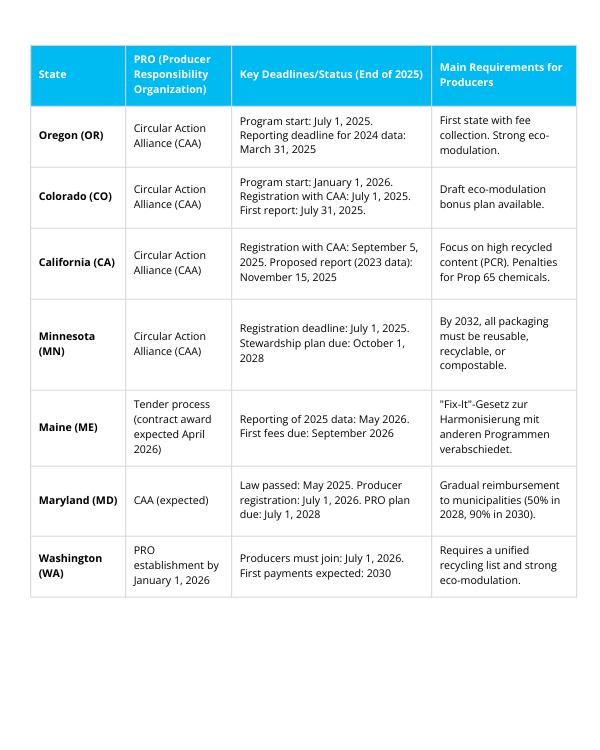
The following seven states have adopted EPR legislation for packaging. Implementation phases differ, but producer obligations are already beginning.
Detailed Review of Active Programs
Oregon (OR): Oregon is the pioneer in the United States. Producers that exceed the thresholds were already required to register and report their packaging quantities in 2025. Fee collection has begun, with costs estimated per pound of material placed on the market. Strong eco-modulation rewards sustainable packaging designs and penalizes materials that are difficult to recycle.
Colorado (CO): With the program starting on January 1, 2026, time is of the essence. Registration with the CAA and the first quantity report in July 2025 were critical steps. Companies that missed these deadlines should act immediately. Colorado also plans eco-modulation, creating incentives for refill/reuse systems and the use of post-consumer recycled (PCR) content.
California (CA) – SB 54: The strictest law in the USA
California, the largest U.S. market, has adopted one of the most far-reaching EPR laws in the country with Senate Bill 54 (SB 54), officially known as the Plastic Pollution Prevention and Packaging Producer Responsibility Act.
Key elements of SB 54:
- 100% target: The law aims for 100% of all packaging and single-use plastic food service ware to be recyclable or compostable in the state by 2032.
- Reduction targets: Specific reduction targets for plastic packaging are established, making SB 54 the first legislation in the United States to mandate such targets.
- Registration and deadlines: Registration with the Circular Action Alliance (CAA) was due in September 2025. The first quantity report (for 2023 data) is proposed for November 2025.
The role of Proposition 65 (Prop 65): A central and stringent aspect of California’s EPR is its linkage with Proposition 65 (Safe Drinking Water and Toxic Enforcement Act of 1986). This list contains over 900 chemicals that are classified in California as carcinogenic or toxic to reproduction.
- Eco-modulation and Prop 65: The eco-modulation rules under SB 54 provide that packaging containing chemicals listed under Prop 65 will be subject to penalties. This is intended to actively prevent the use of problematic substances in packaging.
- Relevance for producers: Because Prop 65-listed chemicals can be present in many components of packaging (such as inks, adhesives, and labels), producers must carefully review their material composition to avoid penalties and comply with eco-modulation requirements.
Minnesota (MN): The registration deadline in July 2025 was critical, as failure to comply can result in high daily penalties. Minnesota is pursuing a long-term goal: by 2032, all packaging must meet one of three criteria (reusable, recyclable, or compostable).
Consequences of Non-Compliance: Severe Penalties Loom
EPR laws in the United States are associated with significant sanctions for companies that fail to meet their registration and reporting obligations. The level of penalties varies depending on the state and the severity of the violation, but they can quickly become existential threats.
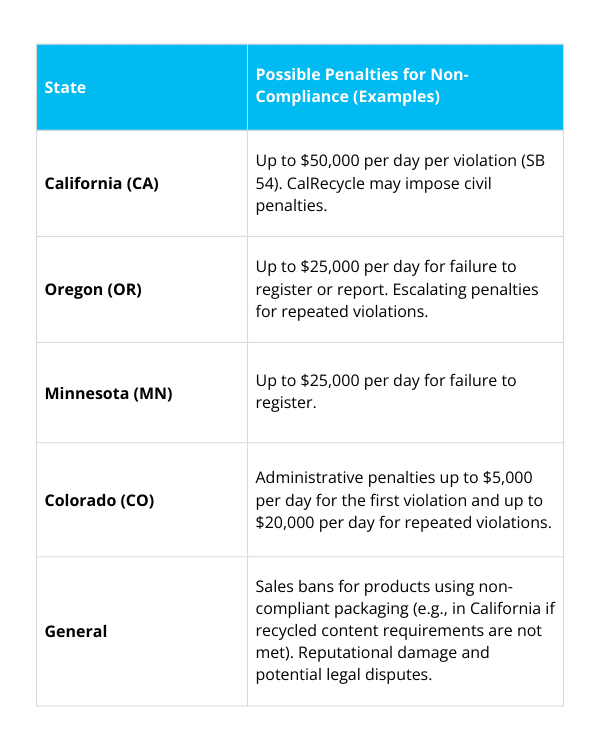
Penalties are often assessed on a daily basis, meaning that the total amount can quickly accumulate in cases of ongoing non-compliance. Particularly in California and Oregon, where penalties can reach up to $50,000 and $25,000 per day respectively, compliance is an existential necessity.
Important: In some states, such as Oregon, failure to register or failure to be a member of the PRO constitutes a Class 1 violation, which carries the highest penalties.
Concrete Action Recommendations for Affected Companies
The complexity of U.S. EPR laws requires a structured approach. As a producer, you should immediately initiate the following steps:
- Review your producer obligation: Determine whether your company qualifies as a “covered producer” based on the revenue and volume thresholds of each individual state. These thresholds vary significantly and must be assessed individually.
- Registration with the PRO: Where the Circular Action Alliance (CAA) has been designated as the PRO (OR, CO, CA, MN, MD), registration there is the first step. In Maine and Washington, developments of the respective PROs must be monitored.
- Data aggregation and reporting: Immediately begin collecting detailed data on the type, weight, and material of your packaging placed on the market in each state (including primary, secondary, and tertiary packaging). Quantity reporting is the basis for calculating your fees.
- Assessment of eco-modulation: Analyze how your current packaging performs under the eco-modulation rules of the states (especially OR, CO, CA, WA). Adjust your packaging design to benefit from lower fees and avoid penalties.
Conclusion: Act Now to Ensure Compliance
The introduction of packaging EPR in the United States is a dynamic process that requires immediate action. With four states already having active registration and reporting obligations, the time to act is now. Compliance is not only a legal necessity, but also an opportunity to make your packaging strategy more sustainable and future-proof.
Secure your compliance with our full-service approach. As your experienced EPR service provider, we offer the expertise needed to navigate the complexity of U.S. laws. We take care of determining your obligations, timely registration with the PROs, and precise quantity reporting, allowing you to focus on your core business.
FAQ: Packaging USA
What is a Covered Producer?
The definition varies by state, but in general, a “covered producer” is a company that sells, distributes, or imports packaged products into the respective state and exceeds certain revenue or volume thresholds. It is crucial to review each state’s specific thresholds, as they differ significantly.
What is the Circular Action Alliance (CAA)?
The Circular Action Alliance (CAA) is the Producer Responsibility Organization (PRO) designated by the states of Oregon, Colorado, California, Minnesota, and Maryland. Producers in these states must register with the CAA and pay their membership fees to ensure compliance.
Which types of packaging are affected?
Generally, all primary, secondary, and tertiary packaging placed on the market in the respective state is affected. This includes plastic, paper, cardboard, glass, and metal. The exact definitions and exemptions (e.g., for certain types of food packaging or medical devices) are specified in the respective state law.
What does eco-modulation mean?
Eco-modulation is a mechanism whereby the fees that producers pay to the PRO are adjusted based on the environmental performance of their packaging. Packaging that is easily recyclable, contains a high share of recycled content (PCR), or is reusable receives lower fees (bonuses). Packaging that is difficult to recycle or problematic (e.g., containing Prop 65 chemicals in California) is subject to higher fees (maluses).
Do I have to register separately in each state?
Yes. Even though the Circular Action Alliance (CAA) operates as the PRO in multiple states, you must fulfill the compliance requirements (registration, quantity reporting) separately for each state in which you exceed the thresholds.
What happens if I miss the deadlines?
As outlined in the section “Consequences of Non-Compliance,” significant daily penalties may apply, reaching up to $50,000 per day in California. In addition, you risk sales bans and reputational damage.