
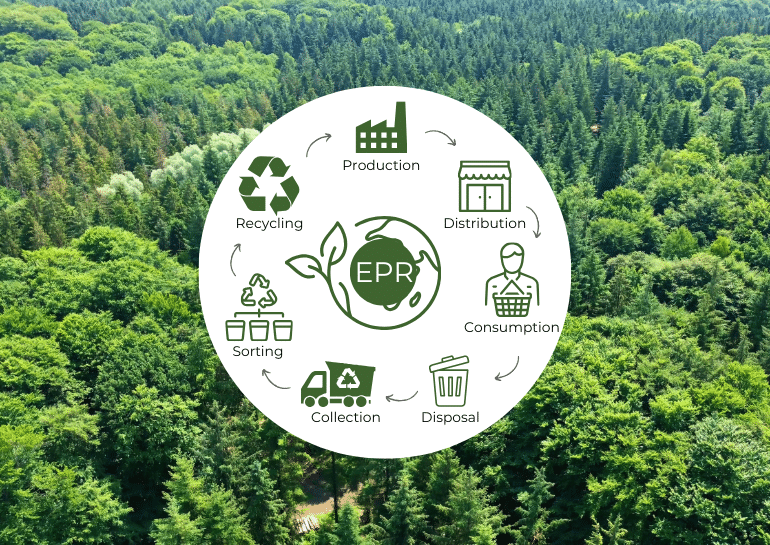
Extended Producer Responsibility (EPR) is an environmental policy principle that requires manufacturers, importers, and distributors to assume responsibility for their products throughout the entire lifecycle – not only during sale and use, but also for collection, recovery, recycling, and environmentally sound disposal at end of life.
EPR is founded on the polluter pays principle, which holds that those who design and place products on the market are best positioned to influence their environmental impact and should therefore bear the associated end-of-life costs. Rather than transferring these costs to taxpayers or public authorities, EPR internalises them into product pricing. This creates a strong economic incentive for businesses to develop products that are more resource-efficient, durable, repairable, and recyclable.
The concept was first formally introduced in 1990 by Swedish environmental economist Thomas Lindhqvist. Germany quickly emerged as a pioneer in implementing EPR. The 1991 Packaging Ordinance was among the first comprehensive regulatory frameworks worldwide to establish producer take-back obligations. Through the introduction of the well-known Green Dot (“Der Grüne Punkt”) scheme, it also laid the foundation for Germany’s dual packaging collection and recycling system.
Since then, EPR has evolved into a cornerstone of both German and European environmental policy. Today, EPR obligations apply to a wide range of product categories, including packaging, electrical and electronic equipment, batteries, single-use plastics, and, from 2025 onwards, textiles.
This article provides an overview of the legal framework, practical implementation, and effectiveness of Extended Producer Responsibility in Germany.
Legal Framework
The EU Waste Framework Directive (Directive 2008/98/EC) establishes EPR as a general principle of European waste policy. With the amendment through Directive (EU) 2018/851, the European legislator introduced mandatory minimum requirements for EPR systems for the first time. These include, among other things, clear definitions of obligations for manufacturers, requirements for cost-bearing, reporting and transparency obligations, as well as the option to modulate financial contributions based on ecological criteria, known as eco-modulation.
At the product level, several EU legal acts specify producer responsibility for individual product groups. The Packaging Directive (Directive 94/62/EC), the WEEE Directive (Directive 2012/19/EU) for waste electrical and electronic equipment, the Batteries Regulation (Regulation (EU) 2023/1542), the End-of-Life Vehicles Directive (Directive 2000/53/EC), and the Single-Use Plastics Directive (Directive (EU) 2019/904) each oblige Member States to implement them into national law. Furthermore, with Directive (EU) 2025/1892, the EU introduced an extended producer responsibility for textiles in October 2025, which must be transposed into national law by June 17, 2027.
Implementation in Germany
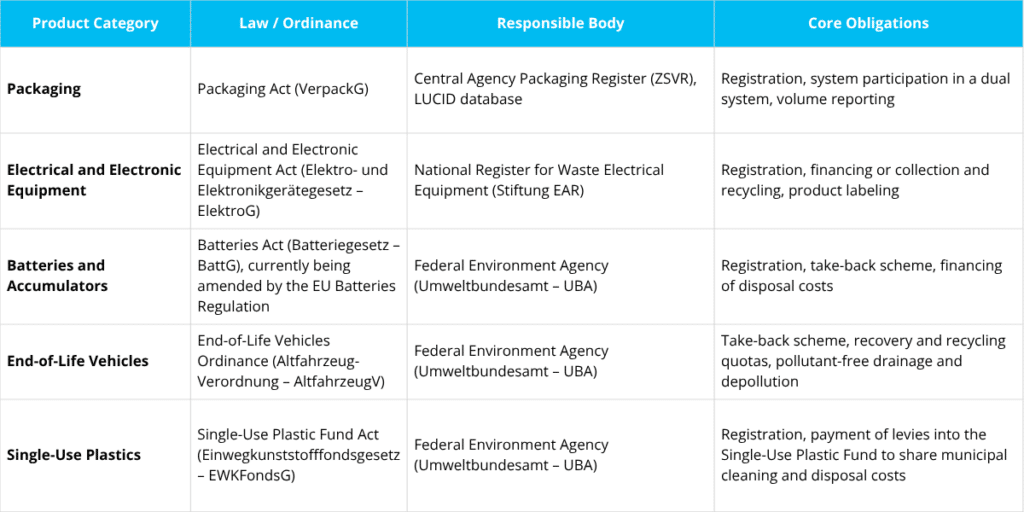
In Germany, product responsibility is regulated as the national manifestation of EPR in Sections 23 to 27 of the Circular Economy Act (Kreislaufwirtschaftsgesetz – KrWG). These regulations apply to anyone who develops, manufactures, processes, treats, or distributes products. Even the predecessor law, the Circular Economy and Waste Act of 1996, had established product responsibility as a core principle in German waste law. With the KrWG of 2012, it was adapted to the evolved European framework.The practical implementation is carried out through product-specific special laws and ordinances, each providing for its own obligations, registration bodies, and enforcement structures:
How Extended Producer Responsibility Works
Before a manufacturer, importer, or distributor places a product on the German market for the first time, they must register with the responsible body. For packaging, this is done via the LUCID database of the ZSVR; for electrical appliances, through the register of the Stiftung EAR; and for batteries, with the Federal Environment Agency. Without a valid EPR registration number, the respective product may not be distributed in Germany.
Registration is followed by financial participation. In the packaging sector, this is known as system participation: the producer (the party placing the product on the market) enters into a contract with one or more dual systems and reports the volumes and material types of their packaging. Based on these volume reports, the dual system calculates a license fee that covers the costs of collecting, sorting, and recycling the packaging. Depending on the material, recyclability, and volume, these fees can vary significantly. For electrical appliances and batteries, financing works on a similar principle, whereby manufacturers either enter into direct contracts with waste management service providers or participate in collective take-back schemes.
Manufacturers can fulfill their obligations either individually or transfer them to Producer Responsibility Organizations (PROs). In Germany, this role is assumed by the dual systems in the packaging sector, and by collective take-back systems such as GRS Batterien or REBAT in the battery sector. The PROs organize and finance the collection, recycling, and reporting on behalf of the affiliated manufacturers, thereby pooling the administrative burden. Especially for smaller companies or foreign manufacturers that do not have a registered office in Germany, cooperating with a PRO or a specialized compliance service provider is often the only viable way to fully meet the legal requirements.
Manufacturers must regularly report the volumes they place on the market, submit an annual declaration of completeness in certain cases, and be able to prove the proper recycling of their products. The responsible authorities and registry bodies cross-check this data and can initiate audits in the event of discrepancies. Violations of registration, reporting, or participation obligations are penalized as administrative offenses and can lead to fines of up to 200,000 euros as well as sales bans.
Figures, Data & Facts on Extended Producer Responsibility in Germany
Whether extended producer responsibility (EPR) achieves its intended objectives is best measured by collection and recycling performance.
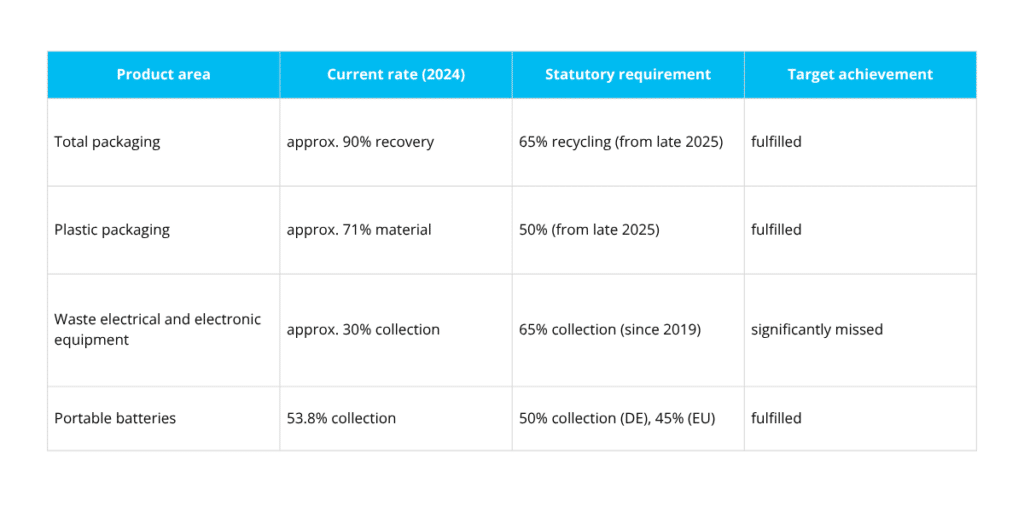
In the packaging sector, Germany has a largely positive track record. In 2024, the dual systems sent approximately 5.5 million tonnes of packaging waste for recovery, representing more than 90% of all packaging covered by the schemes. Progress has been particularly notable for plastic packaging, whose material recycling rate increased from 42% in 2018 to around 71% in 2024. The overall recycling rate for lightweight packaging also exceeded the statutory target, reaching approximately 53% in 2024 compared with the legal requirement of 50%.
The situation is markedly different for waste electrical and electronic equipment (WEEE). Since 2019, the legally mandated minimum collection rate has been 65%. In practice, however, Germany achieved only 29.5% in 2023, with the rate remaining virtually unchanged at around 30% in 2024. As a result, Germany has fallen significantly short of the EU target for several consecutive years. Key factors include the disposal of small electronic devices in residual waste, illegal exports, and an insufficient network of convenient consumer take-back options.
The collection performance for portable batteries has shown a more encouraging trend. In 2024, the collection rate reached 53.8%, exceeding both the German minimum requirement of 50% and the European target of 45%. However, the requirements will become substantially more demanding under the EU Battery Regulation: collection rates of at least 63% must be achieved by 2027 and 73% by 2030.
The following overview compares the current rates with the statutory targets:
Impact on Manufacturers and Market Structures
For manufacturers, the Repairability Score necessitates a shift in product strategy. Repairability is evolving into a key differentiator that must be baked into the design process.
Requirements for manufacturers now include:
- Adopting modular design principles.
- Improving component accessibility.
- Optimizing spare part logistics and supply chains.
- Providing exhaustive technical documentation.
The score impacts the entire value chain. Moving forward, manufacturers must provide transparent, verifiable data. With new monitoring obligations for online marketplaces and stricter verification of EPR registration numbers, a more controlled and compliant environment is taking shape.
Current Developments Regarding Extended Producer Responsibility
Extended Producer Responsibility (EPR) in Germany and Europe is currently in a phase of significant regulatory momentum. Several legislative procedures at the EU level will fundamentally expand the framework and tighten existing regulations in the coming years.
The most far-reaching innovation likely concerns the textile sector. With Directive (EU) 2025/1892, the EU introduced an EPR for textiles for the first time in October 2025. Member states must transpose these requirements into national law by June 17, 2027. For Germany, this means that manufacturers, importers, and distributors of textile products will have to assume take-back, recovery, and financing obligations in the future, similar to what is already the case for packaging or electrical appliances.
Major changes are also imminent in the packaging sector. The EU Packaging and Packaging Waste Regulation (PPWR, Regulation (EU) 2025/40), which entered into force in February 2025, replaces the previous Packaging Directive and applies directly as a regulation in all member states. Among other things, it introduces mandatory recycled content targets for plastic packaging, stricter requirements for recyclability, and new targets for waste prevention. In Germany, the PPWR is expected to replace or supplement major parts of the existing Packaging Act.
In the battery sector, the EU Battery Regulation (Regulation (EU) 2023/1542) is gradually taking effect. Germany is preparing its national implementation with the new Battery Implementation Act (BattDG), which will replace the previous Battery Act. In addition to significantly higher collection targets of 63 percent by 2027 and 73 percent by 2030, the regulation also introduces mandatory minimum shares of recycled cobalt, lead, lithium, and nickel in new batteries for the first time.
Another key instrument that will complement EPR in the coming years is the Digital Product Passport (DPP). Under the EU Ecodesign for Sustainable Products Regulation (ESPR), products will in future be equipped with a machine-readable data set containing information on material composition, repairability, recyclability, and origin. Concrete timelines have already been established for the textile and battery sectors. The DPP aims to create transparency across the entire product lifecycle, thereby also facilitating the implementation of EPR, for example by enabling recycling companies to sort and recover materials more effectively.