

(Last updated: 22.01.2026)
EPR for textiles is a future-relevant topic – for society as a whole, but largely for producers. These are now legally obliged to take responsibility for the EPR for textiles and thus for the recycling of textiles that they have produced themselves. Fast fashion labels in particular are a major problem here, as clothing is not only often manufactured outside the EU and therefore has a long transport route. The quality of the clothing and the standard of the dyes also represent a problem. With the introduction of legal obligations in the form of EPR for textiles, it is becoming clear that these factors are to be brought more to the fore. We will go into some of the most important points for successful and legally compliant recycling for textiles for you!
What does EPR for textiles mean?
With the duty of care for products – also called “General Product Responsibility” – according to § 23 Para. 1 of the Closed Substance Cycle Waste Management Act (KrWG), there is a law that obliges manufacturers to produce resource-efficient products that can be reused several times. However, this law does not oblige manufacturers to recycle the products. This is where EPR for textiles, mattresses, packaging, and many other products comes into play. An EPR (Extended Producer Responsibility) is understood to mean that producers and distributors are no longer only responsible for the products themselves – as is the case with general product responsibility – but also bear responsibility for the entire life cycle of the products. In the case of EPR for textiles, this means that producers must ensure sustainable handling of the textiles they sell even after their product life cycle. This concerns disposal, recycling, and a take-back obligation for textiles.
EPR for textiles – the current state of sustainability
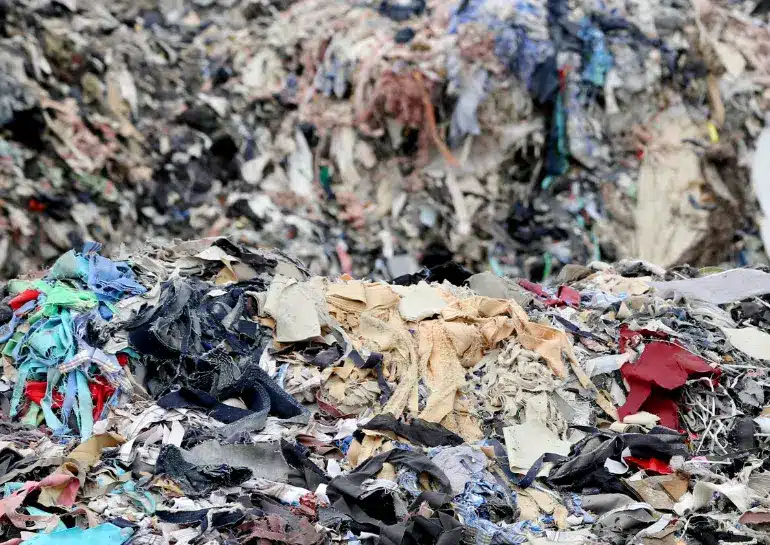
The current situation in the textile industry regarding sustainability has shown a clear negative trend for decades. On the one hand, this is due to the emergence of the throwaway society and the individual consumption behavior of each consumer, and on the other hand, to the production of textiles of inferior quality. Both aspects influence each other. Consumption behavior in society has changed to such an extent that textiles are no longer purchased with long-term intentions. However, this does not only apply to clothing. Under EPR for textiles, other products are also listed such as:
- Bed linen
- Blankets
- Curtains
- Carpets
- Shoes
Through a shortened period of use and the associated reduced quality in production, manufacturers have reduced production costs on the one hand, but have also shortened the longevity of the textiles on the other. With an EPR for textiles – which is structured on the same basic principle as EPR in the toy sector and EPR in electromobility – this behavior is now to be stopped.

Compliance Check: Request Now!
We check whether your company meets the legal requirements, whether processes need to be adapted, and whether costs can be optimized.
With the compliance check from Deutsche Recycling, you are on the safe side: This is how you avoid warnings and threatening fines.
Does the Textile EPR also apply to my company? Guidelines at a glance
In the EU, there have been some changes in recent years focusing on more sustainability. With the Packaging Act, the Battery Act, and also the WEEE Directive, important steps have already been taken. In addition, there was the 2025 update, which brought new regulations for the handling of clothing and shoes, which will be further expanded in 2026. Where previously there were only state incentives, such as the promotion of sustainably produced textiles with an EPR for textiles, there are now concrete requirements that must be met. This includes not only the take-back and sorting obligation, but also the control obligation of online marketplaces. The EU is thus relying on clear and comprehensive standardization of processes for compliance with EPR for textiles. Here, the data collection infrastructure also plays an essential role, which is an integral part of the traceability of manufactured textiles.
Many questions arise for companies. Who is a manufacturer in the EPR sense? Do I have to register separately in each country? And how do I ensure environmental compliance for my company? We advise you comprehensively on EPR for textiles and a legally secure approach.
EPR for textiles across borders in focus
With the ESPR and further innovations within the EU, a lot will change within the EU for 2026 and the further future. For international traders in particular, it is therefore important to stay informed, because only in this way can compliance be ensured and penalties such as sales bans due to EPR violations be avoided. How much do the obligations differ depending on the EU country? And from when do the regulations take effect in the respective countries? We provide an overview.
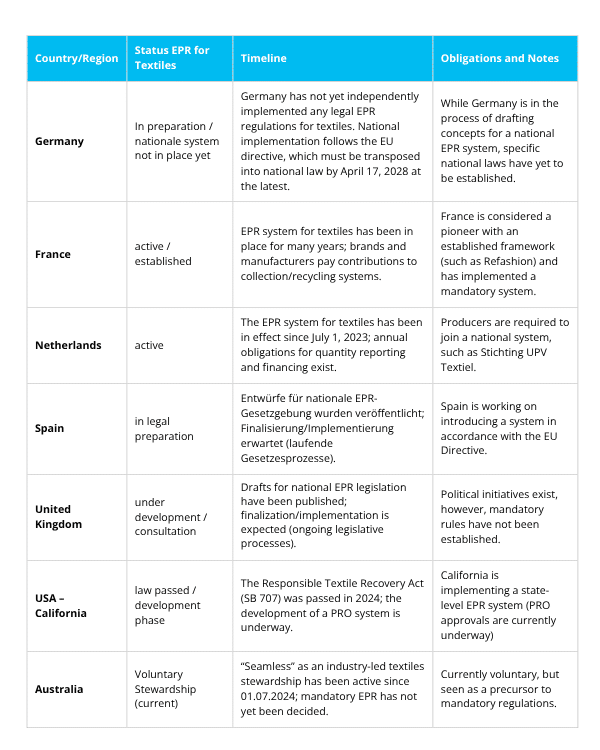
The EPR Directive in France: a pioneer as an example
France was the first European country to anchor an EPR for textiles in law in 2007. The EPR Directive in France imposes one of the following two obligations on companies:
The establishment of an internal program for collection and for EPR for textiles. This program must be accredited by state authorities. The payment of a contribution to Eco TLC to fulfill the goals of the circular economy.
Eco TLC is a non-profit company for EPR for textiles and for the recycling of textiles that has been accredited by the state authorities. The contribution to EPR for textiles that companies have to pay to Eco TLC is calculated individually based on the products placed on the market.
The EPR Directive in France also provides for incentives for companies that put sustainably produced textiles into circulation.
Germany can take the incentives for sustainable production created by EPR for textiles in France as a model. For example, financial support for the circular economy through contributions to be paid would also be desirable here. France was thus a pioneer for the new regulations and directives regarding EPR for textiles.
What do manufacturers need to know about textile recycling?
With the innovation in the course of a binding EPR for textiles, Germany also hopes for a decline in fast fashion and a development towards more quality and environmental friendliness. This in turn could moderate the consumption behavior of customers, who would then buy new goods in smaller quantities due to the higher purchase prices. In addition to producing textiles of higher quality, manufacturers are also obliged to register with their products. As a specialist in the field of environmental compliance, we will support you in the implementation of all obligations and laws around EPR for textiles and also other areas such as EPR for mattresses and used tire disposal.
Our services for your compliance with EPR for textiles
We, Deutsche Recycling GmbH, take on various services for you with absolute legal certainty. If you act as a dealer, freight forwarder, or market participant involved in the production chain, you cannot avoid the topic of waste management. Especially EPR for textiles is incredibly complex due to various national and international regulations. To ensure you don’t lose track in the jungle of paragraphs, we offer you holistic waste management so that you can concentrate fully on your core business again.
Are you unsure which specific requirements apply to you regarding EPR for textiles? Do the compliance check today! Contact us now to prepare appropriately for the upcoming change!
FAQ: EPR for Textiles
Do labels or packaging need to be adapted?
In the context of EPR for textiles, labeling or information obligations may arise. These concern, among other things, instructions for disposal or recycling of the textiles. Uniform EU requirements are partly still under development. Companies should prepare for possible adjustments early on.
In many countries, a local authorized representative is required if the company does not have a registered office in the respective state. This representative takes over communication with authorities and systems for the implementation of EPR for textiles. This is often prescribed, especially for cross-border textile recycling. Whether an authorization is necessary depends on national law.
Who counts as a manufacturer in the context of EPR for textiles?
Any company that places textiles on the market for the first time in a country is considered a manufacturer in the sense of EPR. This also includes importers, online retailers, and brand owners. The decisive factor is not the place of production, but the first provision on the respective market. Foreign companies can therefore also be subject to the textile take-back obligation.
What differences are there in EPR for textiles within the EU?
The implementation of EPR for textiles is currently not uniform in all EU states. Countries like France or the Netherlands already have active systems, others are still in preparation. For manufacturers, this means different obligations for textile recycling. A country-specific audit is therefore essential. In the future, however, these processes are to be standardized.
What consequences are threatened in the event of violations of EPR for textiles?
Violations of EPR can lead to fines, sales bans, or exclusion from marketplaces. Image damage is also possible, especially in the case of a missing textile take-back obligation. The authorities are increasingly relying on control and traceability. Legally compliant implementation is therefore gaining significantly in importance.