

When launching a new product, navigating regulatory requirements is just as critical as perfecting its functionality and design. Product compliance—ensuring absolute alignment with both domestic laws and overarching EU directives—is a non-negotiable step in the go-to-market process.
Historically, the burden of product compliance and verifiable statutory alignment rested solely on the manufacturer. However, under the EU’s updated product safety framework, this liability now spans the entire supply chain. Importers, distributors, fulfillment providers, and online marketplaces all share this regulatory accountability.
Consequently, product compliance remains a critical path item for manufacturers and importers alike. Below, we break down the essential touchpoints to help your business systematically mitigate risks like steep fines, product recalls, marketplace account suspensions, and outright sales bans.
Product Compliance at a Glance
- Definition: Product compliance is the verifiable adherence to all statutory requirements governing a product—spanning safety standards, labeling, packaging, and end-of-life disposal
- Product Safety: The EU General Product Safety Regulation (GPSR) is fully active and legally binding for online retailers, fulfillment providers, and digital marketplaces
- Packaging: The EU Packaging and Packaging Waste Regulation (PPWR) governs market access. In Germany, the Packaging Law Enforcement Act (VerpackDG) has officially superseded the legacy Packaging Act
- Ecodesign: The Ecodesign for Sustainable Products Regulation (ESPR) and the Digital Product Passport (DPP) introduce phased, product-specific mandates for durability, recycled content, and circular repairability
- Green Claims: The EmpCo Directive enforces strict legal boundaries on environmental marketing, heavily restricting terms like “carbon neutral” or “eco-friendly.”
- Liability: Compliance is a shared supply chain liability—every economic operator is held accountable, not just the original manufacturer
The Strategic Value of Product Compliance
The regulatory landscape has shifted dramatically. Driven by rapid technological evolution, heightened safety standards, and an unprecedented societal focus on environmental ESG metrics, compliance frameworks have grown increasingly complex. Modern product compliance ensures that legal, environmental, and safety mandates are engineered directly into the product during the initial R&D and design phases.
The EU has aggressively codified these priorities. Phased rollouts of repairability scoring, textile product passports, and eco-design mandates signal a permanent shift toward a circular economy.
Furthermore, the rise of strict environmental compliance frameworks has made verifiable ecological alignment a prerequisite for market entry. By establishing these rigid frameworks, the EU is cementing long-term standards for environmental protection and commercial sustainability.
Placing a physical product on the EU market requires navigating a radically overhauled regulatory framework. The following core mandates impact virtually all consumer and industrial goods:
- Product Safety (GPSR): Regulation (EU) 2023/988 replaces the legacy Product Safety Directive and major components of Germany’s Product Safety Act. Companies must maintain documented risk assessments, technical dossiers, localized safety warnings for target markets, and comprehensive manufacturer credentials on all digital listings.
- Packaging (PPWR & VerpackDG): Regulation PPWR (EU) 2025/40 enforces direct compliance across the EU. Immediate priorities include strict chemical thresholds (such as heavy metals and PFAS restrictions for food-contact materials), mandatory declarations of conformity per packaging unit, and reusable packaging quotas. Circular design-for-recycling and post-consumer recycled content (PCR) targets will scale next. In Germany, operations must align with the updated VerpackDG framework.
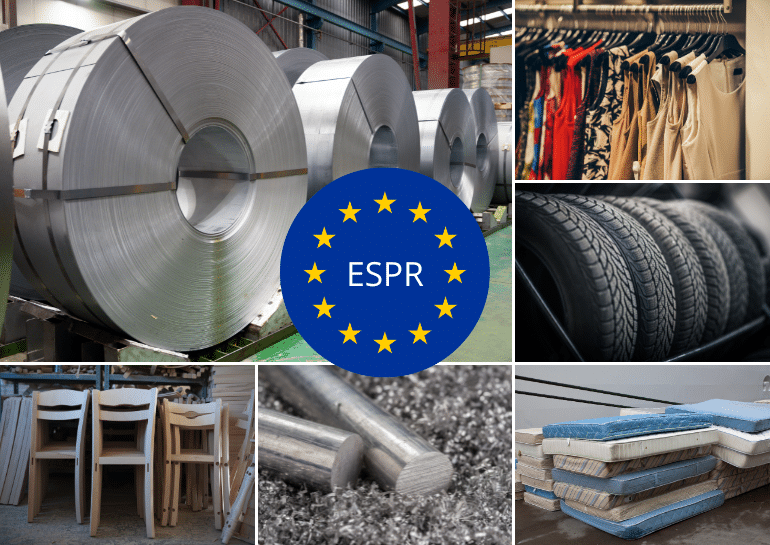
- Ecodesign (ESPR & DPP): Regulation (EU) 2024/1781 serves as the overarching framework, with enforceable rules deployed via product-specific delegated acts. The current multi-year work plan prioritizes high-impact sectors including textiles, furniture, iron, steel, aluminum, and tires.
- Batteries (BattVO & BattDG): The modernized German Battery Act (BattDG) has completely replaced legacy frameworks, expanding battery classifications into five distinct categories. All compliance registrations via the EAR foundation must be tied to a verified Producer Responsibility Organization (PRO). Advanced supply chain due diligence mandates take full effect shortly.
- Deforestation-Free Supply Chains (EUDR): Regulation (EU) 2023/1115 mandates strict traceability. Large and mid-market enterprises are currently subject to these rules, with micro and small enterprises falling under the scope next year. The regulation covers all products containing or derived from wood, paper, rubber, soy, palm oil, coffee, cocoa, and cattle.
- Green Claims (EmpCo): Directive (EU) 2024/825—codified in Germany via the Unfair Competition Act (UWG)—prohibits unsubstantiated, generic environmental claims. Marketing a product as “climate neutral” through basic carbon offsets or displaying unverified, self-styled sustainability badges is illegal. The EmpCo framework stands as the definitive standard following the formal withdrawal of the secondary Green Claims proposal.
A Six-Step Framework for Compliance Verification
Product compliance is not a static checkpoint; it is a continuous operational process. Navigating these bureaucratic hurdles requires a structured internal workflow:
- Map Your Regulatory Scope: Audit your portfolio against global customs tariff numbers to immediately identify which directives govern your specific product categories, materials, and target jurisdictions.
- Assign Supply Chain Roles: Clearly define your legal status (manufacturer, importer, distributor, or authorized representative) across different markets. Note that white-labeling or selling goods under your own brand legally reclassifies your business as the manufacturer.
- Build a Single Source of Truth: Centralize your technical documentation, risk analyses, test reports, and declarations of conformity. These audit trails must be readily accessible and legally archived for ten years.
- Execute Required Registrations: Secure all mandatory corporate registrations, including Germany’s LUCID register for packaging, the EAR foundation for WEEE and batteries, and the respective national registries of your EU target markets.
- Structure Your Product Master Data: Seamlessly integrate compliance attributes—such as statutory warning labels, digital storefront disclosures, and localized disposal instructions—directly into your PIM or ERP infrastructure to prepare for upcoming Digital Product Passport mandates.
- Establish a Regulatory Watchlist: Delegated acts, enforcement guidelines, and national execution laws shift rapidly. Implement a formal quarterly compliance review to audit your pipeline and prevent disruptive supply chain surprises.
Achieve Seamless Compliance with Deutsche Recycling
While achieving an absolute product compliance posture can be resource-intensive, the ramifications of non-compliance—ranging from devastating financial penalties to permanent European sales bans—are severe. At the same time, these evolving directives serve a critical global purpose by actively safeguarding our planet’s ecosystems. Most organizations genuinely want to honor their Extended Producer Responsibility (EPR) but find themselves overwhelmed by the sheer velocity and complexity of these regulatory mandates.
What your business needs now is a dedicated, specialized partner with deep expertise in national and international environmental legislation.
As a leading product compliance service provider, Deutsche Recycling manages the end-to-end conformity of your products and operational workflows. We handle complex registrations and licensing across more than 40 countries, act as your legally authorized representative for EPR compliance, and audit your statutory labeling requirements for packaging, electronics, batteries, and textiles.
Take control of your market access today: Conduct your corporate Compliance Check now to identify exactly which regulatory frameworks govern your current portfolio.
For tailored guidance on environmental or product compliance, please feel free to contact our advisory team at any time. We look forward to supporting your business.
FAQ: Product Compliance
Why is product compliance critical for business continuity?
Without a robust product compliance infrastructure, goods can rapidly transform into severe legal and financial liabilities. Flaws in labeling, missed registrations, or safety oversights frequently trigger steep administrative fines, forced product recalls, and immediate sales bans. The operational disruption is particularly severe when these gaps are discovered post-launch. Maintaining a proactive compliance architecture mitigates these risks before your products ever hit the market.
Who bears ultimate liability for product compliance?
Regulatory accountability is no longer confined strictly to the original manufacturer. Depending on your go-to-market model, importers, distributors, fulfillment service providers, and online marketplaces each face distinct legal obligations. Your compliance exposure is determined entirely by your functional role within the supply chain. Crucially, companies that white-label, rebrand, or distribute goods under their own private label are legally classified and penalized as the primary manufacturer.
Which regulatory frameworks are most relevant to my portfolio?
Applicable compliance mandates depend entirely on the specific properties of your product. For most consumer and industrial goods, frameworks governing general product safety, packaging waste, ecodesign metrics, battery disposal, and environmental marketing claims will intersect. Because these rules are compounded by country-specific national laws within individual target markets, there is no one-size-fits-all compliance checklist.
What role does the GPSR play in modern product compliance?
The General Product Safety Regulation (GPSR) has fundamentally elevated the benchmark for product safety within the EU. Businesses are now legally required to maintain transparent, auditable risk assessments for every product. Furthermore, digital storefront disclosures, localized safety warnings, and explicit credentials for the designated responsible economic operator are strictly enforced. For modern e-commerce and retail operations in Europe, the GPSR is a cornerstone of market access.
How does the Digital Product Passport intersect with product compliance?
The Digital Product Passport (DPP) is designed to centralize and streamline access to product lifecycle data. It creates an audit trail for material composition, repairability scores, operational durability, and recycling capabilities. For businesses, this requires a fundamental shift toward structured product data management. Organizations that proactively optimize their ERP and PIM systems today will face a significantly smoother path to compliance as these passports become mandatory across various product categories.