
There is no centralized EPR regulation at the national level in the United States. Instead, EPR programs are organized at the state level and vary significantly in scope and requirements. Despite progress in some states, EPR implementation in the United States is characterized by a “patchwork legislation” approach.
Some states, including California, Maine, and Vermont, have already introduced comprehensive EPR programs, while others are still discussing such measures or have no EPR regulations at all. This lack of uniformity makes it difficult for companies to understand and comply with requirements across the entire country.
Learn more about Extended Producer Responsibility compliance in the United States with us.
Key EPR Information in America for Quick Readers
Companies that distribute products in the United States must increasingly adapt to Extended Producer Responsibility (EPR) requirements. What makes the U.S. unique is that EPR is regulated at the individual state level, resulting in a wide variety of different regulations.
Recently, states such as Oregon and California adopted new guidelines for the management of batteries and textiles, in some cases modeled after European legislation. Companies from third countries, such as Germany, must therefore pay close attention to the respective state regulations in order to avoid legal risks and penalties.
How widespread is EPR in the United States?
According to the Product Stewardship Institute (PSI), approximately 33 U.S. states have currently implemented EPR programs, and the number continues to grow. Pioneering states such as California and Maine have comprehensive EPR regulations covering various product categories. As progressive states with high population densities, they set a positive example for the future of EPR in the United States.
Implementing a uniform system presents a particular challenge in the United States, as waste management has traditionally been regulated at the state level. Consequently, each EPR program applies only within its respective state and follows independent requirements. This results in a wide variety of regulations, creating significant compliance efforts and costs, particularly for companies operating nationwide. Nevertheless, the trend toward greater responsibility in manufacturing and distribution continues, as demonstrated by California’s new EPR requirements for textiles.
What does EPR look like in the five U.S. states?
While the EU continues refining EPR and introducing new initiatives such as the Repairability Score, EPR for textiles in the United States is still relatively uncommon. We have taken a closer look at some of the leading U.S. states.
Maine
With the passage of its EPR legislation in 2021, Maine became the first state to actively address EPR in the United States. The legislation was revised again in 2025 and is expected to take full effect in 2027. Companies, manufacturers, and retailers must join a Producer Responsibility Organization (PRO) and pay fees for the management of packaging waste. Initial invoices were expected to be issued by May 2026.
Oregon
Oregon followed as the second state in 2021 by passing its EPR packaging law. By July 1, 2025, producers were required to join a PRO and pay the applicable fees, similar to Maine.
Particularly noteworthy is Oregon’s list of recyclable packaging. It specifies what municipalities must accept and which materials must be managed by specialized recycling companies. The statewide list includes common recyclable items as well as certain plastic products. PROs are also responsible for items such as aerosol cans, fuel containers, glass, shredded paper, and other plastic products that cannot be recycled through municipal systems.
In addition, the Oregon Department of Environmental Quality published a framework to help determine whether a product falls under recycling requirements and who qualifies as the “manufacturer” responsible for disposal.
In April 2026, a new battery EPR law was also signed.
California
In California, EPR legislation is expected to take effect in 2032. The list of materials covered under the recycling law has already been defined. The Circular Action Alliance (CAA) has been designated as California’s first Producer Responsibility Organization (PRO).
As in other states, manufacturers of single-use packaging are required under EPR legislation to join a PRO and contribute financially to waste management. Beginning in 2027, producers are expected to pay up to $500 million annually.
By 2032, the PRO must ensure that 100% of packaging is recyclable or compostable and that 65% of single-use packaging is recycled. According to the California government, the EPR law affects approximately 13,615 companies across the state that must now address packaging recycling.
California is also paving the way for the future of textile EPR in the United States and is considered a key pioneer in this area.
Colorado
Colorado, previously known for its low recycling rate, is also taking its first steps toward EPR through the “Producer Responsibility Program for Recycling.” The Department of Public Health and Environment has tasked the Circular Action Alliance (CAA) with administering the program. CAA develops a list of materials considered recyclable.
Colorado’s EPR program launched in January 2026. Under the program, companies must join a PRO and contribute financially to recycling efforts. Prior to the law’s implementation, the recycling rate was only 15%. Companies were required to register by July 2025.
Minnesota
In May 2024, Minnesota became the fifth U.S. state to sign EPR legislation. The Minnesota government adopted the packaging waste reduction law as part of a broader environmental initiative.
Under the new law, manufacturers must cover half of Minnesota’s recycling costs. By 2032, all packaging in the state must be recyclable, reusable, compostable, or collectible.
What does EPR look like in the United States by product category?
EPR legislation in the United States covers various product categories, with each state interpreting the regulations differently. The following categories are currently most affected:
- Packaging: EPR is increasingly being mandated, particularly in Maine and Oregon. Other states such as California have also introduced measures.
- Electronics: Products such as televisions and computers are subject to EPR programs in several states to promote recycling and environmentally sound disposal.
- Batteries: Lithium-ion batteries in particular are regulated in many states because they are considered hazardous waste.
- Mercury-containing products: Thermostats and other mercury-containing products require special disposal and are subject to EPR requirements in states such as Maine and Vermont.
- Pharmaceuticals and sharps (needles): In California and several other states, manufacturers must provide collection and disposal programs for medical products.
The future handling of textiles in California
The law adopted in 2024 creates the first binding textile EPR program in the entire United States. Implementation is being managed by Landbell USA, a company with extensive experience in producer responsibility systems.
The program covers a broad range of products and places particular emphasis on a practical governance structure:
- Take-back obligations apply to nearly all textile consumer goods, from everyday apparel to accessories.
- An advisory committee consisting of industry and retail representatives will contribute market expertise and societal perspectives to program development.
- The establishment of infrastructure for collection, reuse, and repair is a key focus, with operational launch planned for 2030.
The program’s impact is already extending beyond California. States such as New York, Minnesota, and Washington are simultaneously working on their own textile EPR laws. A gradual expansion at the national level is therefore becoming increasingly likely.
Battery EPR in Oregon
Oregon is closing an important gap in its circular economy legislation. The battery EPR program complements the existing electronics recycling system and introduces clear producer responsibility for portable device batteries for the first time.
Key aspects of the program include strong requirements for accessibility and cost responsibility:
- Collection points must be widely available so that nearly the entire state population can access a drop-off location within a reasonable distance.
- Financial and logistical responsibility for the entire disposal process lies entirely with the PRO.
- Partnerships with existing disposal infrastructure, such as landfills and hazardous waste facilities, are legally required.
The program is scheduled to begin in mid-2029. Oregon demonstrates that EPR regulation is increasingly being expanded to product categories that previously received little attention. In doing so, the state is helping redefine battery EPR in the United States.
How does EPR in Canada compare?
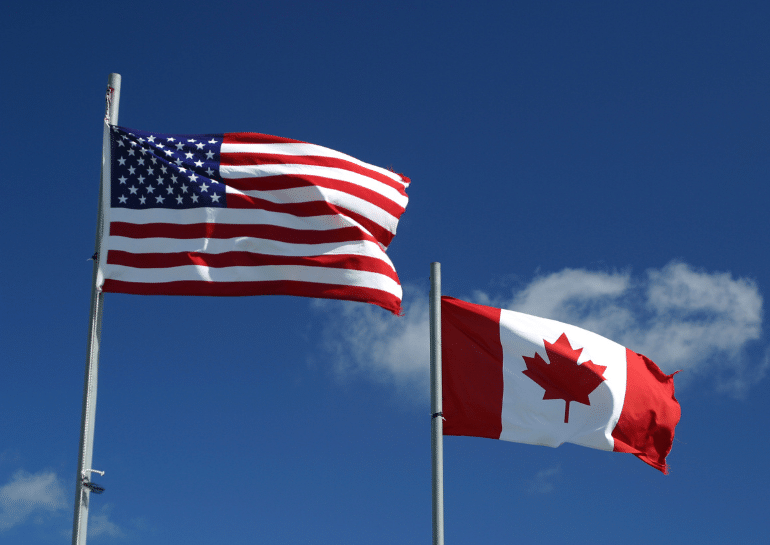
Similar to the United States, Canada’s individual provinces have the authority to develop their own EPR legislation. The provinces of British Columbia, Saskatchewan, Manitoba, Ontario, New Brunswick, Alberta, Quebec, and Nova Scotia already have regulations requiring obligated companies to fully or partially finance packaging recycling systems.
However, compared to the United States, EPR in Canada is already significantly more advanced. As early as 2019, the Canadian Council of Ministers of the Environment published a comprehensive action plan aimed at achieving zero plastic waste. A key component of this plan is the transition from existing stewardship programs to full Extended Producer Responsibility across all provinces.
To facilitate this transition and ensure consistent implementation of EPR across Canada’s eleven provinces and territories, a detailed guidance framework was developed. This framework promotes a harmonized approach and ensures consistent and efficient waste management nationwide.
Successful examples include EPR in Alberta and EPR in Ontario. Ontario has already implemented EPR, while Alberta launched its program in 2025.
What are the specific challenges of EPR in the United States?
Implementing EPR in the United States is considerably more complex than in Europe. On the one hand, each state develops its own EPR regulations. On the other hand, the country’s decentralized legislative structure makes the monitoring and enforcement of EPR requirements significantly more difficult, and not all proposed laws are ultimately approved. In addition, companies in industries such as plastics manufacturing, which have invested heavily in traditional production methods, often seek to prevent or delay such regulations. These factors help explain why EPR implementation in the United States frequently takes many years.
Key challenges include:
- Non-uniform legislation: Companies must review and comply with the regulations of each state individually.
- Costs: Implementing EPR programs in the United States requires significant financial resources to fund take-back systems and recycling programs.
- Compliance complexity: Manufacturers and importers are often required to register products, submit reports, and apply specific labeling, resulting in a substantial administrative burden.
- Additional environmental responsibility: Requirements for environmentally friendly design and increased product durability necessitate investments in research and development.
Which companies are affected by EPR in the United States?
EPR in the United States generally applies to a producer within the supply chain of a specific product. In Maine, a producer is defined as “a person who owns the legal rights to the brand of the products sold or is the sole company importing those products into the state.” Put simply, a producer is a brand owner or entity that sells products.
Since regulations vary from state to state, different types of companies may be affected. There are also exemptions based on revenue levels and company size. For example, companies in Maine with annual revenues below $2,000,000 are exempt from the state’s EPR law.
Obligated producers typically include:
- Manufacturers: Companies that manufacture products sold to businesses or consumers.
- Brand owners: Companies that own the brand under which a product is sold, regardless of who manufactures it.
- Brand licensees: Companies that sell products under a licensed brand.
- Importers: Companies that import products into the United States for sale.
- Distributors: Companies that distribute products within the United States.
- Retailers: Companies may also be considered producers if they sell or import products under their own brand.
What should retailers or manufacturers from third countries consider regarding EPR in the United States?
Manufacturers importing goods that are already subject to EPR requirements in the United States must report their data to one of the relevant PROs and pay fees based on that information. If goods are imported into states without EPR legislation, companies generally only need to ensure that their products comply with applicable safety requirements.
Given the complexity of EPR legislation in the United States, it is advisable to work with the experts at Deutsche Recycling GmbH. This can help companies effectively avoid penalties and fines.
We support you with the licensing of packaging and products in the United States and provide 100% legal certainty through tailored international compliance solutions.
Have our experts conduct your EPR compliance assessment for the United States.
FAQ: EPR in the United States
How does U.S. EPR differ from European regulations?
EPR in the United States operates in a much more decentralized manner than European systems. While many rules are harmonized across the EU, each U.S. state develops its own regulations and timelines. As a result, companies often have to manage multiple programs simultaneously. This significantly increases the organizational burden, particularly for internationally active businesses.
What challenges does EPR in the United States create?
Many companies consider EPR in the United States to be complex because legal requirements are constantly evolving. In addition, registration obligations, fee structures, and recycling targets differ from state to state. Manufacturers and retailers therefore require continuous monitoring of the relevant legal framework. Without professional compliance processes, the risk of penalties and violations increases significantly.
Which states are considered pioneers of EPR in America?
The leading EPR states in America include California, Oregon, Maine, Colorado, and Minnesota. These states have already introduced specific legislation for packaging, batteries, and textiles. California in particular has emerged as a major driver of new EPR regulations. Many other states are now using these models as a reference point.
What is the significance of EPR in Canada compared to the United States?
EPR in Canada is generally considered more advanced than many programs in the United States. Several provinces have introduced clear requirements regarding the financing and administration of recycling programs. Canada is also working toward greater nationwide harmonization of its systems. As a result, companies often benefit from greater planning certainty than in the United States.
What requirements does the PPWR place on the automotive industry and its recyclability?
Beginning in 2030, packaging must be recyclable in accordance with the requirements of the PPWR. For the automotive industry, this means that many existing packaging concepts will need to be reviewed and potentially adapted. Composite materials are a particular focus area. In addition, companies must be able to document and demonstrate the recyclability of their packaging.